Rusty Sabich murder trial and dismissal
Presumed InnocentThe Rusty Sabich murder trial and dismissal ends the prosecution without a jury verdict: after reviewing the record, Judge Larren Lyttle decides that the case rests on suspicion rather than evidence sufficient to justify continuing the trial. The ending is shaped by a last, unsuccessful attempt to obtain a direct confession, the state’s decision to rest, and the judge’s conclusion that justice requires Rusty Sabich to be released from the proceeding rather than left under its continuing threat.
The prosecution’s final attempt
The decisive exchange comes during the prosecution’s examination of Dr. Robinson. Tommy Molto asks whether Rusty ever told him that he had killed Carolyn Polhemus. The question produces a gasp across the courtroom. Rusty, narrating the scene retrospectively, recognizes that this is the answer for which the prosecution brought Dr. Robinson to court: not another question about Rusty’s former relationship with Carolyn, but an attempt to establish that Rusty himself had admitted the murder. The moment concentrates the prosecution’s predicament. After presenting a case built around circumstantial evidence, it makes one last effort to secure direct proof from a witness.
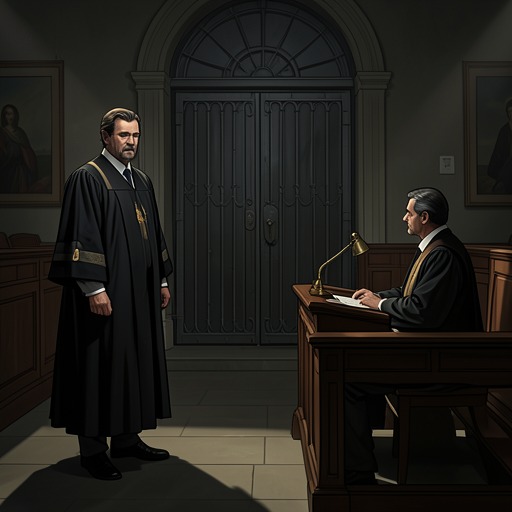
Nico Delia Guardia has been pounding the podium, and Rusty understands that gesture as part of the same effort to force the testimony through. But the judge is furious. He challenges the apparent distinction between questions already treated as privileged and Molto’s question about an alleged confession, then tells Molto that he has had enough and holds him in contempt. The confrontation turns the courtroom’s attention from the answer Molto wants to the propriety of the question itself. The prosecution’s attempt to strengthen its case instead exposes the limits the judge believes it must respect.
Molto does not immediately yield. Nico takes him by the arm and leads him away from the podium while they exchange words. He acknowledges Tommy’s agitation, but his manner conveys resolve rather than the same outrage. When Lyttle asks whether the state rests, Nico answers that it does. This brief exchange ends the prosecution’s presentation and makes the next decision the judge’s: whether the evidence already offered is enough to let the jury deliberate.
Lyttle’s assessment of the evidence
Lyttle tells the jurors that he has reflected on the case at length over the preceding twenty-four hours. He explains the ordinary choice facing a judge when the defense seeks a judgment of acquittal: if the evidence could permit a reasonable jury to find guilt beyond a reasonable doubt, the case generally proceeds. His concern is not simply whether the prosecutors have suspicions. He acknowledges that, before the previous day, he might have regarded those suspicions as reasonable grounds. Now, he says, he is less certain, and he concludes that the evidence is clearly inadequate for the jury to consider fairly.
His explanation identifies several distinct gaps. He finds no proof of motive and no concrete evidence establishing an intimate relationship between Rusty and Carolyn. After the previous day’s proceedings, he sees no effective proof that the two had sexual relations on the night Carolyn died. Nor does he find direct evidence that Rusty murdered her. Lyttle allows that Rusty may have been at Carolyn’s apartment that night and that the state might be entitled to draw that inference; he does not treat that possibility as proof of the murder. The missing glass sharpens his assessment: had the prosecutors found it, he says, he might have felt more confident. Its absence leaves the state without a piece of evidence that could have affected his view of the case.
Lyttle’s ruling rests on the distinction between suspicion and a legally sufficient basis for trial. He tells the jurors that they should not be asked to deliberate on evidence that does not give fair people a basis to find guilt beyond a reasonable doubt. He also emphasizes the burden on the jurors themselves, but makes the defendant’s position paramount: Rusty should not have to remain on trial under what the judge describes as a continuing specter when the evidence cannot sustain the proceeding. The judgment is not a jury’s resolution of the murder accusation; it is the court’s determination that the prosecution has not presented enough to let the case reach that resolution.
The state rests and the case is dismissed
The judge initially indicates that he will dismiss the jury for the weekend and hear the motion for a directed verdict. Instead, he tells the jurors that their service in the case is over and that they may stay if they wish. Rusty does not understand immediately what this means. Jamie Kemp and Sandy Stern embrace him, and their reaction makes clear that the trial has ended. As he listens, Lyttle completes his explanation and sets him free.
Nico stands, but his response does not become an appeal to keep the case moving. He says that he disagrees with the judge while also accepting that the decision is within the law; he does not want his disagreement to be mistaken for a search for excuses. He turns slightly toward Sandy Stern and moves to dismiss the case. Lyttle allows the motion, tells Rusty that he is discharged, and apologizes for what has happened. He calls the episode a disgrace to the cause of justice and wishes Rusty well. The gavel falls, the case is dismissed, and the judge leaves.
Immediate aftermath and significance
The dismissal brings legal release but does not erase the cost of the prosecution. In the courtroom’s turmoil, Rusty is surrounded by his wife, his lawyers, reporters, and onlookers. Barbara reaches him first and embraces him. Rusty registers the contact as astonishing and wonders whether it may mark the beginning of his life’s regeneration. The moment does not establish that their marriage is repaired; it shows instead that his release coincides with a possible emotional opening after the ordeal.
The ending’s force lies in the separation between a case’s formal conclusion and the truth of the murder. Lyttle rules on whether the prosecution has presented evidence adequate for a fair trial, not on who killed Carolyn. His reasons repeatedly return to what the state cannot establish: motive, a concrete intimate relationship, proof of sex on the night of the death, direct evidence of murder, and the missing glass. Rusty is discharged, but the murder accusation receives no jury verdict in this scene. The trial ends because the judge refuses to let suspicion stand in for proof, leaving the court’s legal decision decisive while the larger question of Carolyn’s killer remains unresolved.